 |
| Michelangelo, painted by Marcello Venusti in 1535. |
Michelangelo Was No Beauty
It is no exaggeration to say that Michelangelo Buonarroti (1475-1564) was a complicated human being. The man and the myth that grew around him even in his own lifetime are difficult to disentangle. Arrogant with others and constantly dissatisfied with himself, he nonetheless penned tender poetry. In spite of his legendary impatience and indifference to food and drink, he committed himself to tasks that required years of sustained attention, creating some of the most beautiful human figures ever imagined.
He constantly cried poverty, even declaring to his apprentice Ascanio Condivi: "However rich I may have been, I have always lived like a poor man," yet he amassed a considerable fortune that kept his family comfortable for centuries. And though he enjoyed the reputation of being a solitary genius and continually withdrew himself from the company of others, he also directed dozens of assistants, quarrymen, and stonemasons to carry out his work.
The second of five sons, Michelangelo di Lodovico Buonarroti Simoni was born in 1475 in the town of Caprese, located in the Florentine territory of Italy near Arezzo, Tuscany. The son of a magistrate, Michelangelo shocked his family in 1488 by becoming an apprentice to painter Domenico Ghirlandaio and then studied with sculptor Bertoldo di Giovanni in the Medici gardens in Florence. While honing his skills, he was influenced by prominent people who expanded his views on the arts, especially Lorenzo de' Medici and his school, who introduced him to poets, artists, and scholars in his inner circle.
Early in his career, Michelangelo pursued artistic perfection in his representation of the human body. His meticulousness led him to anatomy, which he studied fervently, even gaining permission from the prior of the church of Santo Spirito to study cadavers in the church's hospital. During this time, he began a lifelong practice of drawing and sketching to prepare for future works of art and architecture.
Following the death of Lorenzo de' Medici in 1492, Michelangelo left Florence, moving from Venice to Bologna and eventually Rome, where he continued sculpting and studying classical works. During this period the French ambassador in the Holy See commissioned the "Pietà" for Saint Peter's Basilica in the Vatican (1498-99).
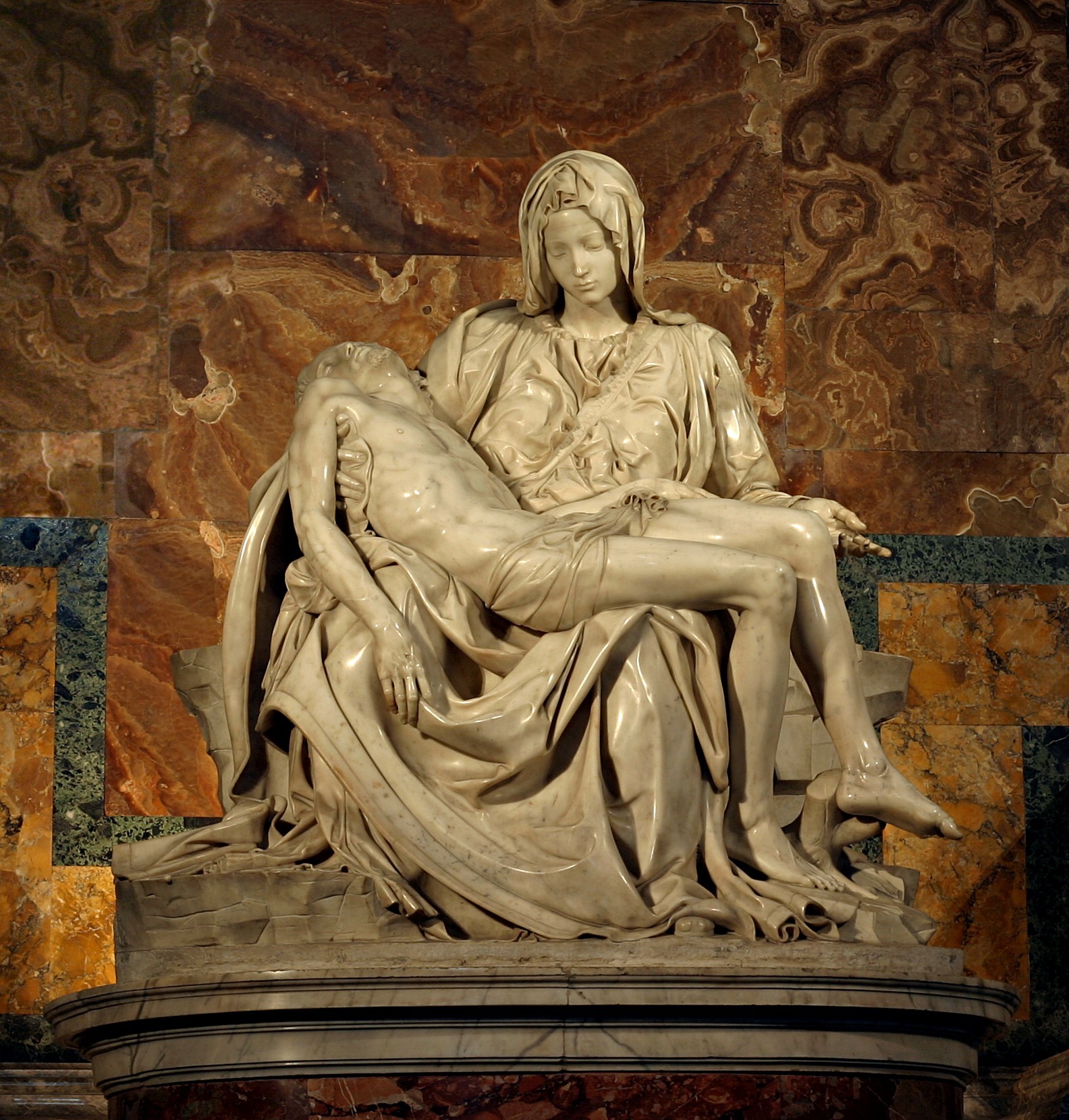 |
| Michelangelo's Pietà in St. Peter's Basilica in the Vatican |
 |
| Michelangelo's_David |

