Sviatoslav
Richter. Legendary Concert in London
Noscere Audere Velle Tascere Ire: rifts on Arts, music, photography, history, literature, poetry, science, the paintings, visual arts, the dance and ultimately to the living spaces of nature by Nosauvelta. This is a look for the space between thinking, knowing, seeing, understanding and listening well, reading stories and thoughts of what was, what is, and what has to be as told by the wise through blogs, photos, video, and music blogs.
If There Is Much In The Window There Should Be More In The Room
Showing posts with label sviatoslav richter. Show all posts
Monday, January 5, 2015
Sunday, March 2, 2014
Chopin Documentary - The Women behind the Music
Tweet
This documentary
is about the life of the great pianist and composer Chopin and the story of the
women whose voices inspired his music. It is undeniable that Chopin revolutionized
the nature of music composed for the piano both technically and emotionally.
What is less well known is that the actual musical instrument that provided his
greatest source of inspiration was the female voice.
To mark the 200th anniversary of Chopin's birth, this film follows young pianist James Rhodes on a journey to Warsaw, Paris and London to discover the real women who had such a powerful influence on the composer.
Exploring the events of Chopin's life, Rhodes encounters the singers who enchanted the composer with their voices: Konstancja, a young soprano and the object of his teenage affections; Delfina, the sexually notorious Polish Parisian emigre countess; fellow composer and opera singer Pauline Viardot; and, during the final few months of his life, the Swedish operatic superstar Jenny Lind.
Threaded through the narrative of the film is a selection of Chopin's piano music performed by Rhodes, while rising young opera singer Natalya Romaniw performs some of the signature arias that thrilled Chopin.
Featuring contributions from Chopin experts including the interpreters Emanuel Ax and Garrick Ohlsson, his biographer Adam Zamoyski and piano guru Jeremy Siepmann.
Chopin’s extant compositions were written primarily for the piano as a solo instrument. Though they are technically demanding his style emphasizes nuance and expressive depth.
Chopin invented musical forms such as the ballade and was responsible for major innovations in forms such as the piano sonata, waltz, nocturne, étude, impromptu and prélude. His works are mainstays and masterpieces of Romanticism in 19th-century classical music.
Frédéric Chopin's four ballades are one-movement pieces for solo piano, composed between 1835 and 1842. They are some of the most challenging pieces in the standard piano repertoire...
(more on Sviatoslav Richter in Kiev, 1959/60 - Chopin, The Four Ballades & Etudes.....)
Chopin Documentary - The Women behind
the Music
March 1 is Frédéric Chopin's
birthday - although some people celebrate it on February 22nd.
As written by Jeremy
Nicholas: Few composers command such universal love as Chopin; even fewer have
such a high proportion of their entire output remaining in the active
repertoire. He’s the only great composer whose every work involves the piano –
no symphonies, operas or choral works and only a handful of compositions that
involve other instruments. He wrote just under 200 works; 169 of these are for
solo piano.
To mark the 200th anniversary of Chopin's birth, this film follows young pianist James Rhodes on a journey to Warsaw, Paris and London to discover the real women who had such a powerful influence on the composer.
Exploring the events of Chopin's life, Rhodes encounters the singers who enchanted the composer with their voices: Konstancja, a young soprano and the object of his teenage affections; Delfina, the sexually notorious Polish Parisian emigre countess; fellow composer and opera singer Pauline Viardot; and, during the final few months of his life, the Swedish operatic superstar Jenny Lind.
Threaded through the narrative of the film is a selection of Chopin's piano music performed by Rhodes, while rising young opera singer Natalya Romaniw performs some of the signature arias that thrilled Chopin.
Featuring contributions from Chopin experts including the interpreters Emanuel Ax and Garrick Ohlsson, his biographer Adam Zamoyski and piano guru Jeremy Siepmann.
Chopin’s extant compositions were written primarily for the piano as a solo instrument. Though they are technically demanding his style emphasizes nuance and expressive depth.
Chopin invented musical forms such as the ballade and was responsible for major innovations in forms such as the piano sonata, waltz, nocturne, étude, impromptu and prélude. His works are mainstays and masterpieces of Romanticism in 19th-century classical music.
Frédéric Chopin's four ballades are one-movement pieces for solo piano, composed between 1835 and 1842. They are some of the most challenging pieces in the standard piano repertoire...
(more on Sviatoslav Richter in Kiev, 1959/60 - Chopin, The Four Ballades & Etudes.....)
Labels:
1959,
1960,
Adam Zamoyski,
BBC,
documentary,
Emanuel Ax,
etudes,
four ballades,
frederic chopin,
Garrick Ohlsson,
James Rhodes,
Jeremy Siepman,
kiev,
Natalya Romaniw,
sviatoslav richter
Tuesday, October 1, 2013
Beethoven's Concerto for Piano, Violin, and Cello in C, Op. 56 - Triple Concerto
Tweet
The triple concerto is dedicated to Prince Franz Joseph Maximilian von Lobkowitz. The triple concerto would seem to have been composed between April-September 1804. It received its first known performance in May 1808, and was published in 1807 in Vienna, yet it had already been anticipated in 1802 by fairly substantial sketches for a work in D, calling for the same team of soloists.
But the 40-minute-long Concerto for violin, cello, and piano in C major, Op. 56, known as the Triple Concerto, was the first major piece Beethoven wrote after he and Archduke Rudolph began working together. Cast in three movements with huge parts for the two string soloists and a musically crucial one for the pianist, it premiered in 1808, and there is no record of Rudolf ever having played it. When it came to be published, the concerto bore a dedication to another patron, Franz Joseph Max, or the Prince von Lobkowitz.- allthingsstrings
It may have been intended for a concert in spring of that year. However, the director of the theatre cancelled the concert, leaving Beethoven to turn his attention to the opera.
After a difficult boyhood in Bonn, Beethoven had chosen to settle in his adoptive Vienna, and in the space of five or six years (making much allowance for the gestation and lengthy reworking of his ideas) produced a quantity of masterpieces astonishing by any standards, including the third symphony, the Waldstein and Appassionata sonatas, Fidelio, the Fourth Piano Concerto, the three Razumowsky Quartets and the Violin Concerto.
At this time he was coming to terms with increasingly "meaty" sonata-form structures. The Waldstein and the triple concerto display the lengthiest first movements he had undertaken by that time, and several ideas in the concerto may have been distilled from the piano sonata.
Beethoven's Triple Concerto for violin, cello and piano was written in 1804, after his deafness had plunged him into the depths of depression and at a time when he had begun to rediscover both his confidence and his desire to express himself. It is a work which will tug at your emotions on many levels. A gentler piece of music than the symphonies, it has no less depth and power. The balance and contrast of the three solo instruments demands concentrated listening.
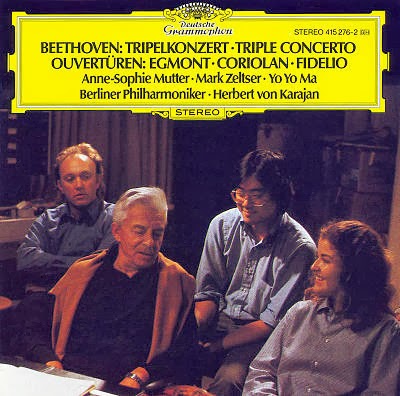
The three soloists - Anne-Sophie Mutter, Mark Zeltser, and Yo Yo Ma -
play with passion, authority, and balance.
There are joyful, as well as bleak, qualities to the Triple, qualities which orchestra and soloists bring to the fore. From the first note you are riveted. It is the sense of authority, the sense of confidence in the blend between soloists and orchestra which is most striking. This is an invigorating recording, one which commands your ear and invites you to listen and feel the emotion.
Ludwig van Beethoven (1770 - 1827)
Concerto for Piano, Violin, and Cello in C, Op.56
1) 1. Allegro [17:48]
2) 2. Largo - attacca [5:50]
3) 3. Rondo alla Polacca [12:32]
http://grooveshark.com/profile/Anne+Sophie+Mutter+Mark+Zeltser+Yo+Yo+Ma+Herbert+Von+Karajan+Berlin+Philharmonic+Orchestra/23163960
Anne-Sophie Mutter - Violin
Mark Zeltser - Piano
Yo-Yo Ma - Cello
Berliner Philharmoniker
Herbert von Karajan
“The warm, expansive music-making confirms even more clearly than before that the old view of this as one of Beethoven's weaker works is quite wrong. The three Soviet soloists revel in the multiplicity of ideas, with Richter in the spare piano part providing a tautening influence.” Penguin Guide, 2011 edition
With three soloists of this high caliber sharing the stage in one concert is quite something, but to have them playing on the same work is fairly unheard of. Couple them with Herbert Von Karajan and what have you got - a flawlessly intuitive recording, especially on the heart-rending second movement.
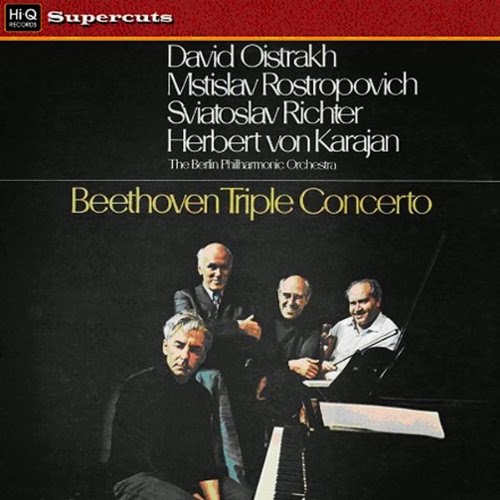
There is a marvelous dialogue taking place in this concerto between the three main players, David Oistrakh on violin, Mstislav Rostropovich on cello, Sviatoslov Richter on piano, and the Berlin Philharmonic Orchestra masterfully conducted by Herbert von Karajan. These were the great classical maestros of days gone by.
Conductor, Herbert von Karajan
*original post May 2, 2011
The triple concerto is dedicated to Prince Franz Joseph Maximilian von Lobkowitz. The triple concerto would seem to have been composed between April-September 1804. It received its first known performance in May 1808, and was published in 1807 in Vienna, yet it had already been anticipated in 1802 by fairly substantial sketches for a work in D, calling for the same team of soloists.
But the 40-minute-long Concerto for violin, cello, and piano in C major, Op. 56, known as the Triple Concerto, was the first major piece Beethoven wrote after he and Archduke Rudolph began working together. Cast in three movements with huge parts for the two string soloists and a musically crucial one for the pianist, it premiered in 1808, and there is no record of Rudolf ever having played it. When it came to be published, the concerto bore a dedication to another patron, Franz Joseph Max, or the Prince von Lobkowitz.- allthingsstrings
It may have been intended for a concert in spring of that year. However, the director of the theatre cancelled the concert, leaving Beethoven to turn his attention to the opera.
After a difficult boyhood in Bonn, Beethoven had chosen to settle in his adoptive Vienna, and in the space of five or six years (making much allowance for the gestation and lengthy reworking of his ideas) produced a quantity of masterpieces astonishing by any standards, including the third symphony, the Waldstein and Appassionata sonatas, Fidelio, the Fourth Piano Concerto, the three Razumowsky Quartets and the Violin Concerto.
At this time he was coming to terms with increasingly "meaty" sonata-form structures. The Waldstein and the triple concerto display the lengthiest first movements he had undertaken by that time, and several ideas in the concerto may have been distilled from the piano sonata.
Beethoven's Triple Concerto for violin, cello and piano was written in 1804, after his deafness had plunged him into the depths of depression and at a time when he had begun to rediscover both his confidence and his desire to express himself. It is a work which will tug at your emotions on many levels. A gentler piece of music than the symphonies, it has no less depth and power. The balance and contrast of the three solo instruments demands concentrated listening.
The three soloists - Anne-Sophie Mutter, Mark Zeltser, and Yo Yo Ma -
play with passion, authority, and balance.
There are joyful, as well as bleak, qualities to the Triple, qualities which orchestra and soloists bring to the fore. From the first note you are riveted. It is the sense of authority, the sense of confidence in the blend between soloists and orchestra which is most striking. This is an invigorating recording, one which commands your ear and invites you to listen and feel the emotion.
Ludwig van Beethoven (1770 - 1827)
Concerto for Piano, Violin, and Cello in C, Op.56
1) 1. Allegro [17:48]
2) 2. Largo - attacca [5:50]
3) 3. Rondo alla Polacca [12:32]
http://grooveshark.com/profile/Anne+Sophie+Mutter+Mark+Zeltser+Yo+Yo+Ma+Herbert+Von+Karajan+Berlin+Philharmonic+Orchestra/23163960
Anne-Sophie Mutter - Violin
Mark Zeltser - Piano
Yo-Yo Ma - Cello
Berliner Philharmoniker
Herbert von Karajan
Audio CD (October 25, 1990)
Label: Deutsche Grammophon
David Oistrakh, Mstislav Rostropovich and
Sviatoslav Richter join the Berlin Philharmonic Orchestra conducted by Herbert
von Karajan for a truly legendary recording event!
The label waited many years to get these legendary artists together for this recording and the result was one of the greatest recordings this work has ever received.
“The warm, expansive music-making confirms even more clearly than before that the old view of this as one of Beethoven's weaker works is quite wrong. The three Soviet soloists revel in the multiplicity of ideas, with Richter in the spare piano part providing a tautening influence.” Penguin Guide, 2011 edition
With three soloists of this high caliber sharing the stage in one concert is quite something, but to have them playing on the same work is fairly unheard of. Couple them with Herbert Von Karajan and what have you got - a flawlessly intuitive recording, especially on the heart-rending second movement.
There is a marvelous dialogue taking place in this concerto between the three main players, David Oistrakh on violin, Mstislav Rostropovich on cello, Sviatoslov Richter on piano, and the Berlin Philharmonic Orchestra masterfully conducted by Herbert von Karajan. These were the great classical maestros of days gone by.
Conductor, Herbert von Karajan
Violinist, David
Oistrakh
Cellist, Mstislav
Rostropovich
Pianist, Sviatoslav
Richter
The Berlin Philharmonic Orchestra
*original post May 2, 2011
Friday, August 23, 2013
A Tchaikovsky Recital - Richter
Tweet
Nocturne op.10 n°1 0:00
Waltz-Scherzo op.7 4:29
Humoresque op.10 n°2 8:45
Capriccioso op.19 n°5 11:25
Chanson triste op.40 n°2 15:20
Waltz op.40 n°8 18:19
Romance op.5 21:39
Romance op.51 n°5 28:16
Un poco di Chopin op.72 n°15 36:59
L'espiègle op.72 n°12 40:25
Rêverie du soir op.19 n°1 42:35
Menuetto-Scherzoso op.51 n°3 46:58
Valse de salon op.51 n°1 51:07
Méditation op.72 n°5 56:12
The Seasons op.37b
May. White Nights 1:01:32
June. Barcarole 1:06:01
November. Troika 1:11:47
January. By the Fireplace 1:14:45
Pyotr Tchaikovsky(1840 -1893)
created a great number of piano
works. These compositions were intended to serve specific purposes and be
performed in certain environments. Works like the First Piano Concerto
were created for big concert halls to celebrate solemn moments of Russian
history and unify the national spirit. Miniatures were usually performed
at home, in a circle of friends and family. They are a symbol of the
privacy and comfort of many wealthier Russian homes and reflect their style of
life in the 19th century. Though Tchaikovsky's piano miniatures were
addressed mostly to nobles and prosperous townsfolk, his music speaks to
everyone. Intimate and sincere, with rich melodies and simple to perform,
the music gained great popularity for the composer.
This album combines Tchaikovsky piano
miniatures from Op. 5, 7, 10, 19, 40, 51 and 72.
Sviatoslav Richter (1915-1997),
one of the greatest pianists of the twentieth century, was born in Zhitomir, Ukraine, into a family of musicians. His talent was recognized and encouraged from a very early stage. The Richters soon moved from Zhitomir to Odessa, a provincial city in Southern Ukraine. Theophil Richter, father of Sviatoslav, was a professor at Odessa Conservatory. At the same time and in the same city lived also David Oistrakh and Emil Gilels. By the age of eight Richter played opera scores by Wagner and at age nineteen he gave his first solo piano concert.
Richter won the All-Union Competition in 1945 and was awarded the Stalin Prize in 1949. Being a jury member at the First Tchaikovsky Competition in 1958 he awarded van Cliburn one hundred points out of possible ten.
The communist regime kept Soviet artists on a short leash and there was a reason for that. Too often Soviet artists chose not to return. The first time Richter was allowed to cross the border with the West was at the end of 1960. That was his debut in the US with the Second Concerto by Brahms conducted by Erich Leinsdorf. After that Richter played seven recitals over ten days in Carnegie Hall. He became an extremely busy performer. However he also became known for cancellations of his performances at the very last minute. He tried to avoid travelling by air. The exhausting life of a travelling concert pianist was not his cup of tea.
Richter preferred to stay in France and Germany. The environment around Tours in France reminded him of Zhitomir. In 1964, Richter founded an annual festival - the "Fetes Musicales en Touraine" at Meslay. He also established the December Nights Festival which annually takes place at the Pushkin Museum of Fine Arts in Moscow.
Richter's repertoire was vast, though the music he performed was selected very consciously. Besides basic piano repertoire he loved to play sonatas by Schubert and Haydn which evoked delight in his audiences. As time passed Richter's interpretations became more and more rigid and restrained, though each composer was always for him a special world and Richter treated each of them very differently, naturally and easily. A natural ability to merge different styles and epochs was probably his most impressive talent, though most people first of all valued his unlimited abilities as a virtuoso.
After 1980, the only light he allowed in the concert hall was focused on the piano and around the same time he stopped playing by heart though his memory was always extraordinary.
Richter's last concert was in Lubeck, Germany, in March, 1995. He was eighty years old and in poor health. On the program were three Haydn Sonatas and Variations by Beethoven. Richter died in Moscow on August 1, 1997.
one of the greatest pianists of the twentieth century, was born in Zhitomir, Ukraine, into a family of musicians. His talent was recognized and encouraged from a very early stage. The Richters soon moved from Zhitomir to Odessa, a provincial city in Southern Ukraine. Theophil Richter, father of Sviatoslav, was a professor at Odessa Conservatory. At the same time and in the same city lived also David Oistrakh and Emil Gilels. By the age of eight Richter played opera scores by Wagner and at age nineteen he gave his first solo piano concert.
We often hear funny things about Richter. For example,
that his development as a pianist started when 22-year-old Richter first met
Heinrich Neuhaus in Moscow. In fact when Neuhaus listened to Richter's
playing he said that there was nothing he could teach him. Being already
an accomplished pianist Richter never passed the exam to enter the Moscow Conservatory
as a student. He was enrolled without examination after Neuhaus listened
to his playing. Can we imagine the same happening at our state music
schools which charge 100$ only for applying and where composers and performers
are evaluated by accountants according to form-filling instead of personal
inspiration and experience? Indeed, Neuhaus knew that real diplomas are
issued in Heaven.
Richter won the All-Union Competition in 1945 and was awarded the Stalin Prize in 1949. Being a jury member at the First Tchaikovsky Competition in 1958 he awarded van Cliburn one hundred points out of possible ten.
The communist regime kept Soviet artists on a short leash and there was a reason for that. Too often Soviet artists chose not to return. The first time Richter was allowed to cross the border with the West was at the end of 1960. That was his debut in the US with the Second Concerto by Brahms conducted by Erich Leinsdorf. After that Richter played seven recitals over ten days in Carnegie Hall. He became an extremely busy performer. However he also became known for cancellations of his performances at the very last minute. He tried to avoid travelling by air. The exhausting life of a travelling concert pianist was not his cup of tea.
Richter preferred to stay in France and Germany. The environment around Tours in France reminded him of Zhitomir. In 1964, Richter founded an annual festival - the "Fetes Musicales en Touraine" at Meslay. He also established the December Nights Festival which annually takes place at the Pushkin Museum of Fine Arts in Moscow.
Richter's repertoire was vast, though the music he performed was selected very consciously. Besides basic piano repertoire he loved to play sonatas by Schubert and Haydn which evoked delight in his audiences. As time passed Richter's interpretations became more and more rigid and restrained, though each composer was always for him a special world and Richter treated each of them very differently, naturally and easily. A natural ability to merge different styles and epochs was probably his most impressive talent, though most people first of all valued his unlimited abilities as a virtuoso.
After 1980, the only light he allowed in the concert hall was focused on the piano and around the same time he stopped playing by heart though his memory was always extraordinary.
Richter's last concert was in Lubeck, Germany, in March, 1995. He was eighty years old and in poor health. On the program were three Haydn Sonatas and Variations by Beethoven. Richter died in Moscow on August 1, 1997.
Titan. That is the first word that comes to mind when
thinking of the pianist Sviatoslav Richter. Not only for the imposing physical
presence (Richter frightened the orchestra conductor, Rozhdestvensky) but also
because of the way he grasped the keyboard. Was it because he had as professor
at the Moscow Conservatory, the famous Heinrich Neuhaus?
One
can hardly find fault in Richter’s playing. He unleashes all of his power, with an
infallible sense of rhythm.
Direct
and warm, these pieces are a part of his soul and he delivers them with just
the right combination of technical panache and sentimentality.
It’s
rare indeed to get such a broad sampling of Tchaikovsky’s shorter solo piano
works, and to have them played by a great Russian pianist like Richter is a
bonus.
Sviatoslav Richter, piano Recorded
in Studio 3 of the Bavarian Radio, 1983. Engineered by Wolfgang Karreth DDD
Licensed from Olympia
Nocturne op.10 n°1 0:00
Waltz-Scherzo op.7 4:29
Humoresque op.10 n°2 8:45
Capriccioso op.19 n°5 11:25
Chanson triste op.40 n°2 15:20
Waltz op.40 n°8 18:19
Romance op.5 21:39
Romance op.51 n°5 28:16
Un poco di Chopin op.72 n°15 36:59
L'espiègle op.72 n°12 40:25
Rêverie du soir op.19 n°1 42:35
Menuetto-Scherzoso op.51 n°3 46:58
Valse de salon op.51 n°1 51:07
Méditation op.72 n°5 56:12
The Seasons op.37b
May. White Nights 1:01:32
June. Barcarole 1:06:01
November. Troika 1:11:47
January. By the Fireplace 1:14:45
Subscribe to:
Posts (Atom)