If There Is Much In The Window There Should Be More In The Room

Friday, October 9, 2009

Pas de Deux pt deux


View entire film:
http://www.nfb.ca/film/pas_de_deux_en/

A thirteen minute live action short subject filmed by Norman McLaren of the National Film Board of Canada. It had been nominated for an Oscar, and won a BAFTA, the year before, in 1968. The film was entitled 'Pas de deux'.

The film’s subject is simply two ballet dancers, photographed on high contrast black and white stock, on a bare stage, with harsh side lighting.

It was in its post production manipulation, however, that the film became truly memorable. McLaren passed the original image through an optical printer, up to eleven times at some places, to produce a beautiful stroboscopic image of movement.

The film tells the story of a female Narcissus who is completely self -involved until a young man appears to win her attention. It is a plea that we must look outside ourselves and love others, the same theme which underlay McLaren’s Oscar winning 1952 short feature, Neighbours.

If you have ever seen it before, you will remember this film. If you have not seen it before, it is well worth the expenditure of time, regardless of whether you do, or do not, enjoy ballet.

Thursday, October 8, 2009

Pas de Deux pt1


Pas de deux (1968) is an award winning film by Scottish-Canadian director Norman McLaren, produced by the NFB.

The film sees two performers dancing a pas de deux, filmed on high contrast film stock with very stark side lighting. This is augmented by step-and-repeat printing on an optical printer. This gives the film an almost stroboscopic appearance.

Biographer Maynard Collins points out that the "technical virtuosity of this film, its ethereal beauty, its lovely Roumanian pan-type music, made it a joy to watch, even if - perhaps, especially if - you do not care for ballet."

Norman McLaren's Oscar-nominated short film Pas de Deux (1969) is a beautiful surreal dream. Pas de Deux bends our perception of movement, shape and form—and ballet itself—as two dancers, first seen in normal dance become endless reflections of themselves. McLaren became a ground-breaking abstract experimental filmmaker accumulating a body of influential short films.

In the film "Pas de deux" he does more than a recording of choreography. Much like with Norman McLaren other work the process of the recording is part of it's art.

He exposes the same frames as many as ten times, creating a multiple image of a ballerina and her partner. Black background and backlit figures coupled with pan pipes produce a quiet and detachment similar to that of his film Lines.

It contains components of both abstract and realism but unlike his other pieces it leans closer to the realistic end of the spectrum. One dancer is made to appear to be dancing with herself.

When the male dancer is introduced it then becomes more based on design there are trails of movement that are used as brush strokes as an artist paints on a canvas. Then the art fades as another stroke begins.

One would consider him from the impressionists school of theory. His works appeared to depart from realism. He was famous, for even using live subjects, having them appear animated.

His use of juxtaposition, rupture and speed alteration exemplify this in his films.
There is a feeling of dream like motion incorporated into the choreography through his work.

Pas de deux captures an aspect of dance that the human eye would not be able to achieve alone. It shows the use of patterns made through space in a clear fashion.....


Tuesday, October 6, 2009

Vortex Smoke Ring Collision


vortex ring collision 

http://youtu.be/XJk8ijAUCiI


 Once generated two similar swirls with opposite angular speed, they increase the size of your radio to go forward. The speed with which approach becomes increasingly smaller, and increases the size of its radius faster. The radius will increase until both swirls disintegrate. If both are perfectly symmetrical eddies, the velocity of fluid elements parallel to the axis of symmetry in the middle between eddy and swirl is equal to zero. This line generated by all points where the velocity is zero, becomes a solid border where the speed through the wall is zero.


Smoke rings collide - If they did that in sci-fi movies, viewers would be all like, "Oh, come on, that's not even close to realistic!"


This is what physicists do when they're high.... :)

Friday, September 18, 2009

N I G H T


Rating:★★★★★
Category:Books
Genre: Biographies & Memoirs
Author:Elie Wiesel

Note: Although Night is not necessarily a memoir, it is often referred to as one, since the work’s mixture of testimony, deposition, and emotional truth-telling renders it similar to works in the memoir genre.

It is clear that Eliezer is meant to serve, to a great extent, as author Elie Wiesel’s stand-in and representative. Minor details have been altered, but what happens to Eliezer is what happened to Wiesel himself during the Holocaust.

It is important to remember, however, that there is a difference between the persona of Night’s narrator, Eliezer, and that of Night’s author, Elie Wiesel.


Night is narrated by Eliezer, a Jewish teenager who, when the memoir begins, lives in his hometown of Sighet, in Hungarian Transylvania. Eliezer studies the Torah (the first five books of the Old Testament) and the Cabbala (a doctrine of Jewish mysticism). His instruction is cut short, however, when his teacher, Moshe the Beadle, is deported. In a few months, Moshe returns, telling a horrifying tale: the Gestapo (the German secret police force) took charge of his train, led everyone into the woods, and systematically butchered them. Nobody believes Moshe, who is taken for a lunatic.

In the spring of 1944, the Nazis occupy Hungary. Not long afterward, a series of increasingly repressive measures are passed, and the Jews of Eliezer’s town are forced into small ghettos within Sighet. Soon they are herded onto cattle cars, and a nightmarish journey ensues. After days and nights crammed into the car, exhausted and near starvation, the passengers arrive at Birkenau, the gateway to Auschwitz.

Upon his arrival in Birkenau, Eliezer and his father are separated from his mother and sisters, whom they never see again. In the first of many “selections” that Eliezer describes in the memoir, the Jews are evaluated to determine whether they should be killed immediately or put to work. Eliezer and his father seem to pass the evaluation, but before they are brought to the prisoners’ barracks, they stumble upon the open-pit furnaces where the Nazis are burning babies by the truckload.

The Jewish arrivals are stripped, shaved, disinfected, and treated with almost unimaginable cruelty. Eventually, their captors march them from Birkenau to the main camp, Auschwitz. They eventually arrive in Buna, a work camp, where Eliezer is put to work in an electrical-fittings factory. Under slave-labor conditions, severely malnourished and decimated by the frequent “selections,” the Jews take solace in caring for each other, in religion, and in Zionism, a movement favoring the establishment of a Jewish state in Palestine, considered the holy land. In the camp, the Jews are subject to beatings and repeated humiliations. A vicious foreman forces Eliezer to give him his gold tooth, which is pried out of his mouth with a rusty spoon.

The prisoners are forced to watch the hanging of fellow prisoners in the camp courtyard. On one occasion, the Gestapo even hang a small child who had been associated with some rebels within Buna. Because of the horrific conditions in the camps and the ever-present danger of death, many of the prisoners themselves begin to slide into cruelty, concerned only with personal survival. Sons begin to abandon and abuse their fathers. Eliezer himself begins to lose his humanity and his faith, both in God and in the people around him.

After months in the camp, Eliezer undergoes an operation for a foot injury. While he is in the infirmary, however, the Nazis decide to evacuate the camp because the Russians are advancing and are on the verge of liberating Buna. In the middle of a snowstorm, the prisoners begin a death march: they are forced to run for more than fifty miles to the Gleiwitz concentration camp. Many die of exposure to the harsh weather and exhaustion.

At Gleiwitz, the prisoners are herded into cattle cars once again. They begin another deadly journey: one hundred Jews board the car, but only twelve remain alive when the train reaches the concentration camp Buchenwald. Throughout the ordeal, Eliezer and his father help each other to survive by means of mutual support and concern. In Buchenwald, however, Eliezer’s father dies of dysentery and physical abuse. Eliezer survives, an empty shell of a man until April 11, 1945, the day that the American army liberates the camp.


ANALYSIS


Although we know that Elie Wiesel, Night’s author, recovered his faith in man and God and went on to lead a productive life after the Holocaust, none of this post-Holocaust biographical information is present in Night.

Because the scope of Night does not extend beyond Eliezer’s liberation, some readers argue that the memoir offers no hope whatsoever. Eliezer has been witness to the ultimate evil; he has lost his faith in God, and in the souls of men.

Night’s final line, in which Eliezer looks at himself in the mirror and sees a “corpse,” suggests that Eliezer’s survival is a stroke of luck, a strange coincidence, no cause for rejoicing. It seems from his closing vision that Eliezer believes that without hope and faith, after having seen the unimaginable, he might as well be dead.

Night does not end with optimism and a rosy message, but neither does it end as bleakly as many believe. What we are left with are questions—about God’s and man’s capacity for evil—but no true answers.

Night does not try to answer these questions; perhaps this lack of answers is one of the reasons that the story ends with the liberation of Buchenwald. The moral responsibility for remembering the Holocaust, and for confronting these difficult moral and theological questions, falls directly upon us, the readers.

Thursday, September 17, 2009

Dialogus - They are Alive


An event revolutionizes our minds. Its outcome: People who have marked history accept to come out of their isolation and are willing to participate in a huge conversation with whoever wants to write to them - as long as their questions are constructive and respectful.

Intellectuals are not dead to intervene in our current debates.

You can write to these personalities and they will reply to you.
People who made history will come out of their isolation and agree to participate in a great dialogue with anyone who wants to write them.


See more at: http://www.dialogus2.org/


English site: http://www.dialogus2.org/enindex.html


Thursday, September 3, 2009

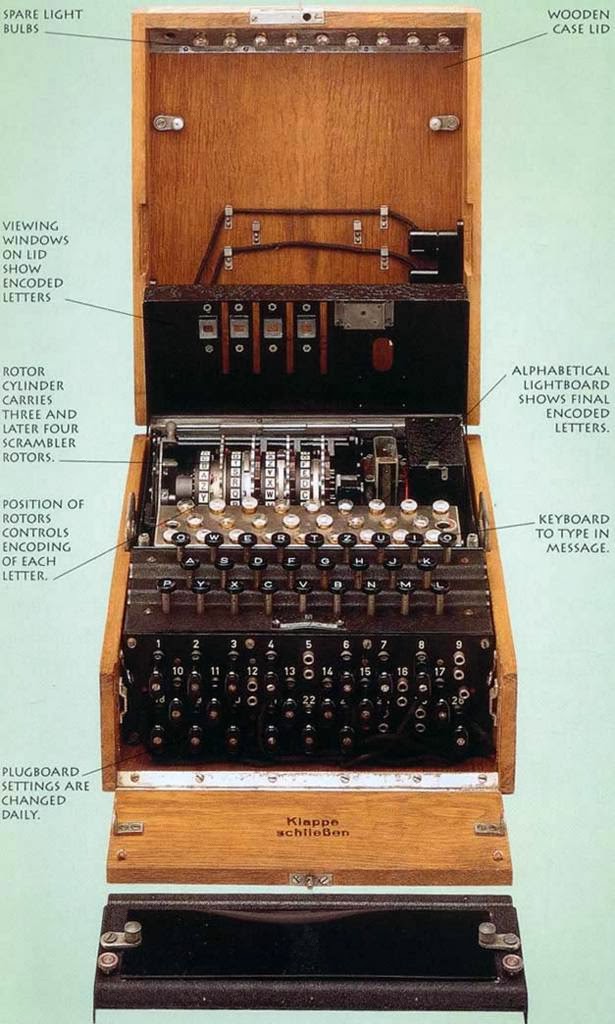
Decoding Nazi Secrets - How the Enigma Works


http://www.pbs.org/wgbh/nova/decoding/enigma.html#diagram


Possibly the most well-known of all cipher machines is the German Enigma. It became the workhorse of the German military services, used to encrypt tens of thousands of tactical messages throughout World War II. The number of mathematical permutations for every keystroke is astronomical. However, the Enigma is not famous for its outstanding security, but rather for its insecurities. Allied forces were able to read most of the Enigma encrypted messages throughout most of the war as a result of the tireless effort of many Allied cryptologists.


The Enigma machine, first patented in 1919, was after various improvements adopted by the German Navy in 1926, the Army in 1928, and the Air Force in 1935.

It was also used by the Abwehr, the Sicherheitsdienst, the railways, and other government departments.

From then until 1939, and indeed throughout the war, successive refinements were introduced, varying from service to service, and there were detailed changes in operating procedure until 1945....


Thursday, July 16, 2009

I Musici 1988 - [HD] Antonio Vivaldi - Summer/The Four Seasons


In 1952, twelve young and promising Italian musicians, mainly roman and mostly graduates of the at the Accademia di Santa Cecilia in Rome, got together "inter pares" to create a unique chamber orchestra comprising six violins, two violas, two cellos, one double bass and one harpsichord.

They chose the simple, yet nice, name I MUSICI and they deliberately decided to shape the ensemble without conductor.

They did so in order to create an egalitarian relationship among the twelve colleagues and friends, which would bring to their music-making a unanimity on technical and interpretative questions.

It was a very unconventional but unexpectedly suitable procedure. Notably, maestro Arturo Toscanini, on hearing them rehearsing in April 1952 at the Italian Radio studios, enthused over the young orchestra in front of journalists and musical personalities, and dedicated his photograph to the group with the words “bravi, bravissimi …no! la musica non muore”, (bravo, the music will not die).

A few weeks earlier, on the 30th of March 1952, their public debut was an enormous success at the Accademia di Santa Cecilia in Roma; it was the starting point of an astonishing career, which in a short time catapulted them among the ranks of the great international performers.

During the course of the years, the musicians have changed, the original members of the group retired but, together with the younger talent that has taken their place, there has always been a generation of “historic” members present who guarantee the tradition and continuity of the orchestra.

At present I Musici are regular guests at the most important international festivals and they carry out an intense concert activity in prestigious theatres and concert halls such as: “G Enescu” International Festival in Bucharest, Colon Theatre in Buenos Aires, Carnegie Hall and Lincoln Centre in New York, the “Spring Festival” in

Budapest, Sunthory Hall and Opera City in Tokyo, the Musikverein in Vienna, the Philharmonie in Berlin, Palau de la Musica in Barcelona, Seoul Arts Centre, Boston Symphony Hall, Shanghai Concert Hall, Beijing National centre for the Performing Arts and numerous others.

The twelve musicians in I Musici, together transformed the joyous Sinfonia RV 149 by Vivaldi, into a furious vortex of strings. There, everything bubbled and danced as if in a turbulent Venetian carnival. It was irrelevant and charming and always very stylish.

I Musici built on the experience of their previous performances without ever becoming dogmatic. A pulsating bass (harpsichord and double bass) gave particular emphasis to the orchestra. Everything was played in a natural and spontaneous manner, exactly as it should have been.

"There are cigars and there are CUBAN COHIBAS,

there are red wines and there are CHATEAU LAFITE ROTHSCHILDS.

There are performances of TheFour Seasons and there is I MUSICI'S FOUR SEASONS."

The masterful interpretation of Vivaldi's Four Seasons has been always a best seller and was recorded in six successive versions (PHILIPS)


Antonio Lucio Vivaldi - Summer - The Four Seasons - Le Quattro Stagioni - "L' Estate" - Concerto No. 2 in G minor, Op. 8, RV 315  
00:00 I. Allegro non molto
05:30 II. Adagio e piano - Presto e forte
08:11 III. Presto

I Musici Group. Violin Solo, Federico Agostini, 1988
Anton van Munster Film (1934-2009)


Antonio Vivaldi must be regarded as the indisputable king of the Baroque instrumental concerto. Four concertos, known collectively as The Four Seasons, were first published in 1725 as part of a set of twelve concerti, Op. 8, entitled Il cimento dell'armonia e dell'inventione (The Contest Between Harmony and Invention) and remains the composer's best-known and most characteristic work. 

Aside from the features that have come to be associated with most of Vivaldi's music - grace, virtuosity, energetic motoric rhythms - the concertos of The Four Seasons are remarkable for their extraordinary programmatic imagination, which is counterbalanced by close attention to formal structure. Each concerto is accompanied by a descriptive poem whose imagery becomes an essential element of the musical fabric. The birds that greet the season "with their joyful song" in La primavera (Spring), for example, are colorfully depicted in the work's elaborately ornamented figuration. L'estate (Summer) is painted in similarly vivid colors that portray both the piping of a shepherd and a gathering storm. L'autunno (Autumn) is marked by a folksy harvest celebration and the galloping of a hunting party on horseback. The bleakness and dissonance of L'inverno (Winter) create a severe but expressive portrait that provides a striking summation of Vivaldi's pictorial ingenuity in these four works.

SUMMER:


The four violin concertos in The Four Seasons were each inspired by an Italian sonnet, possibly written by Vivaldi himself. In each of the concertos the composer attempts to depict the pastoral scenes and events described in the sonnet. In this Concerto in G minor, subtitled "Summer," he attempts to capture the bright scenery and mood of that warmest of seasons, but the music is more a mixture of good and bad than one might normally think: the sonnet opens: "Under the merciless summer sun...." Thus the first movement, despite its lively Allegro non molto marking, begins as if an oppressive pall hovers above, the music listlessly struggling forward. But soon the pacing turns lively and the mood brightens to depict singing birds and cool breezes. But after a brief tranquil section, the music suddenly becomes violent and frenzied, with the onset of a clash among neighbors. Calm returns soon, but the movement ends breathlessly, as a storm threatens to wreak troubles for the shepherd.


The ensuing Adagio - Presto movement alternates between the lethargic but beautiful playing of the solo violin theme and the stormy interjections of the string orchestra. The text describes the tired shepherd and his fears of thunder and lightning.


The storminess continues at the outset of the Presto finale, as the storm finally does begin to rage. The mood throughout this closing panel, whether in the writing for the orchestra or for the soloist, brims with tension, at times even frenzy, as this storm fells stalks of corn and ravages the countryside. This brief movement provides a brilliant finish to this colorful Concerto.


I MUSICI


This is the Video of the most popular classical works of all. I Musici were the driving force in the rediscovery of Baroque repertoire and their CD recording of The Four Seasons is one of the best-selling Philips discs of all time. I Musici are still considered to be one of the greatest 'modern' string ensembles. These performances by I Musici were filmed in key locations around Vivaldi's city of Venice. This aforementioned mega-hit video contains flashes of Venetian points of interest and art works. The film incorporates panoramic shots of the city as well as some of the great masterpieces of art to be found there by artists such as Canaletto, Guardi and Tintoretto. There are also shots of the fabulous costumes sported by Venice's citizens during its unique winter Carnival. All the four video movements miniatures (posters) are from the Venice Carnival in the 4th last movement.


Tuesday, July 14, 2009

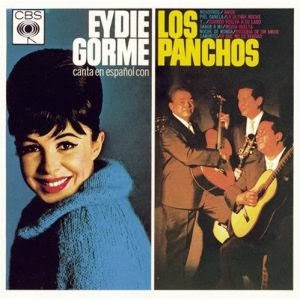
Historia De Un Amor - Eydie Gorme, Trios Los Panchos


“Historia de Un Amor” is among the most popular love songs produced in the last seventy-five years and is a classic of the romantic bolero music repertoire. 

Composed by Panamanian Carlos Eleta Almaran (1918-2013) in 1955, and used for the soundtrack of the 1956 movie of the same title, “Historia de Un Amor” is a song inspired by the passing of his brother’s wife. 

This bolero, both lyrically and musically, powerfully evokes the feelings of love, loss, and longing that are representative of the familiar themes of this genre of Latin music. As such, it has become one of the most universally recorded and performed songs, popular with generations of audiences throughout Latin America, Europe and Asia.

It is also in the soundtrack of a 1956 Mexican movie of the same name. The song tells of a man's suffering after his love has disappeared. It may be interpreted that love is a story for a woman but it's just an episode for a man.

It was sung or played by many artists like Julio Iglesias, Nana Mouskouri, Perez Prado, Laura Fygi, Iva Zanicchi, Eydie Gormé & Trio Los Panchos, Pedro Infante, Dalida, Ana Gabriel, Luis Miguel, Lili Boniche - Guadalupe Pineda - among others.


Ya no estás más a mi lado, corazón.
En el alma sólo tengo soledad.
Y si ya no puedo verte,
¿Por qué Dios me hizo quererte?
¿Para hacerme sufrir más?

Siempre fuiste la razón de mi existir.
Adorarte para mi fue religión.
Y en tus besos yo encontraba
El calor que me brindaba
El amor y la pasión.

Es la historia de un amor,
Como no hay otro igual.
Que me hizo comprender
Todo el bien, todo el mal.

Que le dio luz a mi vida,
Apagándola después.
¡Ay que vida tan oscura!,
¡Sin tu amor no viviré!

Es la historia de un amor.