The Rodin Mythology
"All that I have lived
and loved I have made in my art"
He belongs to the race of those men who march alone - Paul Laurens, the painter, said of Auguste Rodin.

1900 un triomphe pour Rodin Avenue MontaigneAvenue Montaigne
In full Francois-Auguste-Rene Rodin, French sculptor of sumptuous bronze and marble figures, is considerably regarded by some critics to be the greatest portraitist in the history of sculpture. French sculptor and draughtsman, he is the only sculptor of the modern age regarded in his lifetime and afterwards to be on a par with Michelangelo. Both made images with widespread popular appeal, and both stressed the materiality of sculpture.
Rodin’s most famous works—the Age of Bronze, The Thinker, The Kiss, the Burghers of Calais and Honoré de Balzac—are frequently reproduced outside a fine-art context to represent modern attitudes that require poses and encounters freed from allegory, idealization and propriety.
The Rodin mythology embraces the artist’s faith in the spiritual dignity of individuals that direct scrutiny can reveal; this is at its most blatant in Rodin’s portraits of French heroes such as Balzac and Victor Hugo, presented naked and vulnerable.

Rose Beuret
His numerous biographers dwell on his rise from humble origins and his struggle to be accepted by the juries arbitrating entry to the Salon and to be awarded government commissions.
Also part of the myth are the fidelity of Rose Beuret, his companion of 50 years; his brazen sexuality; and the unprecedented international fame Rodin acquired after 1900.
And for most of the 77 years of his life the great sculptor marched alone, first battling his way against the adversities of relentless poverty and hostile criticism and, in the latter years of his life, alone at the head of an international army of enthusiastic admirers. When Rodin presented one of his early pieces to the Academy of Fine Arts, he was told that his work did not “exhibit any evidence of talent,” and some 50 years or so later critics of many places were hailing him as the greatest sculptor of the world — save Michael Angelo — since Pheidias and Praxiteles.
Rodin did not idealize his subjects, but aimed for realism, going to nature for his inspiration. To him, all nature was life and life was art.
 |
| Auguste_Rodin_-_Monument_to_Victor_Hugo |
 |
| Affiche de l'exposition “ Rodin ” au pavillon de l'Alma, 1900 |
BY the turn of the century, Auguste Rodin, a shy man of humble origins who did not come into his own as a sculptor until his mid-30's, dominated the international art world, his influence reaching as far as Japan.
The 165 sculptures that he showed in his specially constructed pavilion at Paris's vast Universal Exhibition in 1900 were a sensational draw.
 |
| expo_universelle1900 |
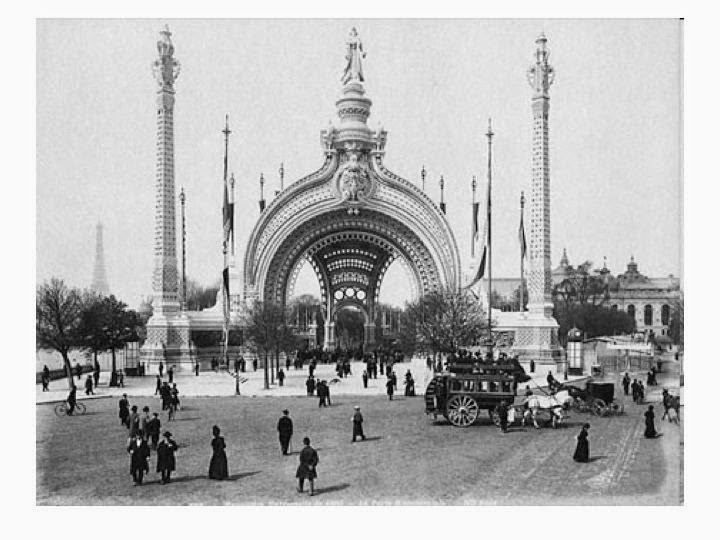 |
| M.R. Binet Port d'Entree 1900. Art Nouveau France - Paris - Exposition Universelle Paris |
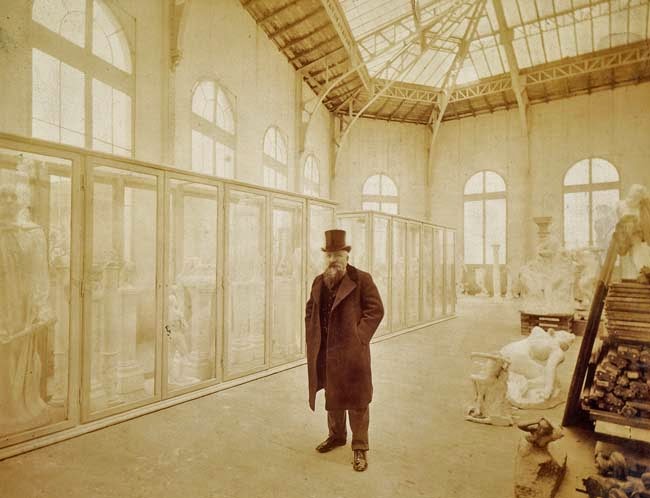 |
| Rodin in front of the showcases of the Pavillon de l’Alma, Meudon, circa 1902 |
 RODIN-EXPO-LABORATOIRE-CREATION |
Thereafter, the master whose celebration of sexuality had once shocked the rich and powerful on both sides of the Atlantic was flooded with commissions.
|

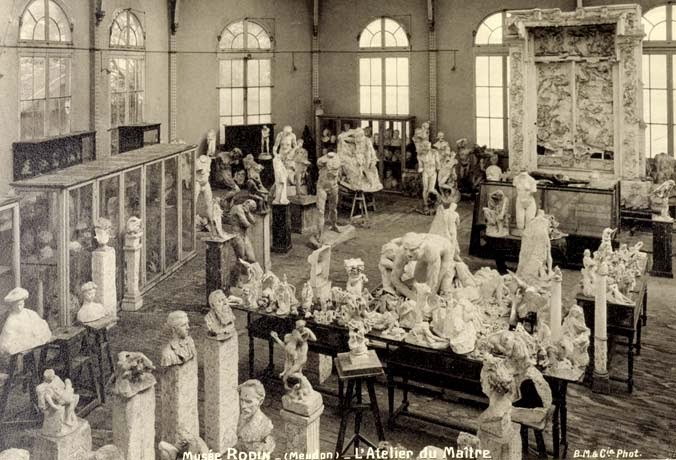 |
| Studio of the Master, Meudon |
 |
| Le_Chateau_d'eau_and_plaza,_Exposition_Universal,_1900,_Paris,_France |
The most influential figures of the day, from Georges Clemenceau to George Bernard Shaw, were proud to sit for him. And King Edward VII even made a special trip to visit the sculptor at his home in Meudon.
 |
| In Rodin’s Studio |
At the beginning of the 20th century Rodin was famous throughout the world and long had been revered as a modern-day Michelangelo, a titan of sculpture, an incarnation of the power of inspired genius.
Even his prodigious sensuality was excused as a symbol of his Olympian stature.
 |
| Le_Musee_RODIN |
In the end it seems there
was scarcely an honor that had not been bestowed on this hard-eyed,
gruff-looking artist. Even in death his fame was secure. His works were housed
in the Hotel Biron, now the Rodin Museum, which is still thronged daily by
admirers from all over the world.
 |
| augusterodin1919 |
Most major museums own
copies of his works, and museums in Paris, Philadelphia, and Tokyo are
dedicated to him. Rodin's prime contribution was in bringing Western sculpture
back to what always had been its essential strength, a knowledge and sumptuous
rendering of the human body.
Why Is
Rodin Important? In the 1860s, when Rodin began making
sculpture, art was deeply rooted in the past — it told stories from religion,
history, myth, and literature, and it told them as if the artist had been a
witness to the events. Just thirty years later, by the peak of his career — the
1890s — Auguste Rodin had transformed sculpture into something that today we
call modern, that spoke to
the artist’s and viewer’s emotions and imaginations.

François-Auguste-René Rodin
The stories that
were told were often internal and conceptual, and there was no right or wrong
way to interpret them. And by the time Rodin died in 1917 he had — through
prodigious talent and a remarkable volume of work — challenged the established
styles of his youth and revolutionized sculpture. Today his pioneering
work is a crucial link between traditional and modern art.
Is Rodin's monumental
masterpiece a failure? This video explains why there are two different versions
of the same artwork, and why Rodin remained obsessed by the Gates until his
death. It shows how the artist managed to solve major aesthetic issues that
faced modern artists at that time.
La Porte de l'Enfer
(The Gates of Hell) by Auguste Rodin depicts a scene from The Inferno, the
first section of The Divine Comedy by Dante Alighieri. The monumental
sculptural ensemble, standing at 6m high by 4m wide and 1m deep
(19.69'x13.12'x3.29'), contains over 180 figures, ranging from 15cm high to
more than one metre--many of which were later cast independently.
La Porte de l'Enfer
was commissioned in 1880 by the Directorate of Fine Arts for an entrance to
their planned Decorative Arts Museum. Although intended for an 1885 delivery,
the museum was never built and Rodin would continue to work on the project on
and off for 37 years, until his death in 1917. Its first public viewing came at
a self-organized one-man exhibition at the Place de l'Alma in 1900.
Right before the
opening, Rodin stripped the Gates of its figures, leaving an unreal space,
modulated by light and shadow. Towards the end of his life, Rodin restored the
figures, but never saw it cast in bronze. In 1917, the original plaster was
restored and is currently on display at the Musée d'Orsay. That model was used
to make the original three bronze casts, including this one at the Musée Rodin.
The other two are in the Rodin Museum in Philadelphia and the National Museum
of Western Art in Ueno Park, Tokyo. Subsequent copies were made and distributed
to a number of locations, including The Kunsthaus Zürich, the B. Gerald Cantor
Rodin Sculpture Garden at Stanford University and the Rodin Gallery in Seoul.
RELATED VIDEOS
Part 4/7
Rodin (2003)
Francois-Auguste Rodin (1840-1917)
Auguste
Rodin is widely considered to be the greatest and most influential sculptor of
the late nineteenth century. A passionate observer of the human body, he
challenged certain conventions of the time and paved the way for modern
sculpture. This film is a unique insight into the sculptor's personality and
working methods, told through the artist's notebooks and letters as well as
archive footage of him in his studio and at Meudon.
Why Is Rodin Important? In the 1860s, when Rodin began making sculpture, art was deeply rooted in the past — it told stories from religion, history, myth, and literature, and it told them as if the artist had been a witness to the events. Just thirty years later, by the peak of his career — the 1890s — Auguste Rodin had transformed sculpture into something that today we call modern, that spoke to the artist’s and viewer’s emotions and imaginations.
|
| François-Auguste-René Rodin |
The stories that were told were often internal and conceptual, and there was no right or wrong way to interpret them. And by the time Rodin died in 1917 he had — through prodigious talent and a remarkable volume of work — challenged the established styles of his youth and revolutionized sculpture. Today his pioneering work is a crucial link between traditional and modern art.
Is Rodin's monumental
masterpiece a failure? This video explains why there are two different versions
of the same artwork, and why Rodin remained obsessed by the Gates until his
death. It shows how the artist managed to solve major aesthetic issues that
faced modern artists at that time.
La Porte de l'Enfer (The Gates of Hell) by Auguste Rodin depicts a scene from The Inferno, the first section of The Divine Comedy by Dante Alighieri. The monumental sculptural ensemble, standing at 6m high by 4m wide and 1m deep (19.69'x13.12'x3.29'), contains over 180 figures, ranging from 15cm high to more than one metre--many of which were later cast independently.
La Porte de l'Enfer
was commissioned in 1880 by the Directorate of Fine Arts for an entrance to
their planned Decorative Arts Museum. Although intended for an 1885 delivery,
the museum was never built and Rodin would continue to work on the project on
and off for 37 years, until his death in 1917. Its first public viewing came at
a self-organized one-man exhibition at the Place de l'Alma in 1900.
Right before the
opening, Rodin stripped the Gates of its figures, leaving an unreal space,
modulated by light and shadow. Towards the end of his life, Rodin restored the
figures, but never saw it cast in bronze. In 1917, the original plaster was
restored and is currently on display at the Musée d'Orsay. That model was used
to make the original three bronze casts, including this one at the Musée Rodin.
The other two are in the Rodin Museum in Philadelphia and the National Museum
of Western Art in Ueno Park, Tokyo. Subsequent copies were made and distributed
to a number of locations, including The Kunsthaus Zürich, the B. Gerald Cantor
Rodin Sculpture Garden at Stanford University and the Rodin Gallery in Seoul.
RELATED VIDEOS
Part 4/7
Rodin (2003)
Francois-Auguste Rodin (1840-1917)
Auguste Rodin is widely considered to be the greatest and most influential sculptor of the late nineteenth century. A passionate observer of the human body, he challenged certain conventions of the time and paved the way for modern sculpture. This film is a unique insight into the sculptor's personality and working methods, told through the artist's notebooks and letters as well as archive footage of him in his studio and at Meudon.
 |
| “The Old Courtesan” |
 |
| 2607492376_8956899bd2_b Eternal Idol |
 |
| 3871516973_c0637b5e0f_o. |
 |
| Adam 1880-1881 Bronze |
 |
| Adam |