If There Is Much In The Window There Should Be More In The Room

Showing posts with label Berliner Philharmoniker. Show all posts

Thursday, January 23, 2014

The Silence that Follows the Music


The musical world had lost one of the greatest and most acclaimed conductors of our age: Claudio Abbado, the best lyrical interpreter of Mahler. This particular performance stands as everlasting testament to his great art, extraordinary musicianship and the unique qualities of his work.


As soon as Abbado lowered his baton his interpretation of the Second Symphony by Mahler became a legend.

An invisible thread runs between Claudio Abbado and the Second Symphony, "Resurrection" by Mahler. It is with this work that he made his debut with the London Symphony Orchestra and the Philharmonic Orchestra of Vienna in Salzburg at the age of thirty-two and it is this symphony he decides to conduct in August 2003 in Lucerne, with the new orchestra that he helped revive, the Lucerne Festival Orchestra. 


An Italian revived it, an Italian had founded it: Arturo Toscanini, who had founded the Lucerne Festival in 1938 to compete with Salzburg, had given this event an orchestra that was to play under the direction of the greatest conductors. After falling by the wayside in the nineties, the new Lucerne Festival Orchestra was reborn in August 2003 like the phoenix reborn from its ashes under the magic baton of Claudio Abbado. 


In the superb concert hall, designed by the architect Jean Nouvel, the stars of the most prestigious formations as well as the leading soloists perform. Among many others one may recognise: Emmanuel Pahud, Sabine Meyer, Renaud and Gautier Capuçon, Natalia Gutman, the Hagen Quartet and Marie-Pierre Langlamet. The simple fact of having succeeded in assembling all these stars is a miracle in itself, the aim is now to get them to play together… And that takes the talent, experience and magnetism of a Claudio Abbado to succeed. 


There was no reason for concern: as soon as the applause died down, the interpretation of the Second Symphony they performed as a single man, went down in legend. Fortunately, cameras and microphones were there to ressuscitate the "Ressurection". – medici.tv


Claudio Abbado doesn't talk. No doubt because he expresses himself with music so intensely that words must seem inadequate to him. 


Saturday, January 4, 2014

New Year's Eve Concert 2014, Berlin / Concert de la St-Sylvestre, Berliner Philharmoniker


New Year's Eve Concert 2014, Berlin / Concert de la St-Sylvestre, Berliner Philharmoniker


This is a tradition. Every year on the 31st of December, music lovers in Berlin go to the Philharmonie and join forces with their orchestra to celebrate the New Year.

Jaunty dance rhythms are a big part of the Silvesterkonzert's programme. This year, Sir Simon Rattle opens the concert with Dvořák's Slavonic Dances, Op. 46. 
Then, Lang Lang plays Prokofiev's virtuoso Piano Concerto No. 3, before the orchestra performs more Slavonic Dances by Dvořák, Hindemith's third Symphonic Dance, as well as three of Aram Khatchaturian's dances from his ballet Gayaneh. There is no doubt the Berliner Philharmoniker will set the Philharmonie on fire with the Soviet-Armenian composer's Sabre Dance! Closing the concert are two of Brahms's most famous Hungarian Dances.

Every year, the Berlin Philharmonic holds a New Year’s Eve Gala Concert at Berlin’s Philharmonic Hall. And this year is no exception. But this time, maestro conductor Sir Simon Rattle and the Berlin Philharmonic have been joined by Chinese pianist Lang Lang.


Tuesday, October 1, 2013

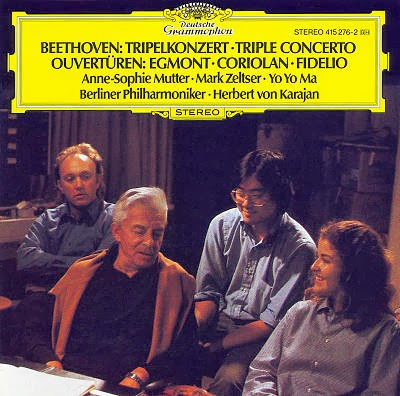
Beethoven's Concerto for Piano, Violin, and Cello in C, Op. 56 - Triple Concerto


The triple concerto is dedicated to Prince Franz Joseph Maximilian von Lobkowitz. The triple concerto would seem to have been composed between April-September 1804. It received its first known performance in May 1808, and was published in 1807 in Vienna, yet it had already been anticipated in 1802 by fairly substantial sketches for a work in D, calling for the same team of soloists. 


But the 40-minute-long Concerto for violin, cello, and piano in C major, Op. 56, known as the Triple Concerto, was the first major piece Beethoven wrote after he and Archduke Rudolph began working together. Cast in three movements with huge parts for the two string soloists and a musically crucial one for the pianist, it premiered in 1808, and there is no record of Rudolf ever having played it. When it came to be published, the concerto bore a dedication to another patron, Franz Joseph Max, or the Prince von Lobkowitz.- allthingsstrings
   
It may have been intended for a concert in spring of that year. However, the director of the theatre cancelled the concert, leaving Beethoven to turn his attention to the opera.

After a difficult boyhood in Bonn, Beethoven had chosen to settle in his adoptive Vienna, and in the space of five or six years (making much allowance for the gestation and lengthy reworking of his ideas) produced a quantity of masterpieces astonishing by any standards, including the third symphony, the Waldstein and Appassionata sonatas, Fidelio, the Fourth Piano Concerto, the three Razumowsky Quartets and the Violin Concerto.

At this time he was coming to terms with increasingly "meaty" sonata-form structures. The Waldstein and the triple concerto display the lengthiest first movements he had undertaken by that time, and several ideas in the concerto may have been distilled from the piano sonata.

Beethoven's Triple Concerto for violin, cello and piano was written in 1804, after his deafness had plunged him into the depths of depression and at a time when he had begun to rediscover both his confidence and his desire to express himself. It is a work which will tug at your emotions on many levels. A gentler piece of music than the symphonies, it has no less depth and power. The balance and contrast of the three solo instruments demands concentrated listening.


The three soloists - Anne-Sophie Mutter, Mark Zeltser, and Yo Yo Ma - 
play with passion, authority, and balance. 

There are joyful, as well as bleak, qualities to the Triple, qualities which orchestra and soloists bring to the fore. From the first note you are riveted. It is the sense of authority, the sense of confidence in the blend between soloists and orchestra which is most striking. This is an invigorating recording, one which commands your ear and invites you to listen and feel the emotion.

Ludwig van Beethoven (1770 - 1827)
Concerto for Piano, Violin, and Cello in C, Op.56
1) 1. Allegro [17:48]
2) 2. Largo - attacca [5:50]
3) 3. Rondo alla Polacca [12:32]


http://grooveshark.com/profile/Anne+Sophie+Mutter+Mark+Zeltser+Yo+Yo+Ma+Herbert+Von+Karajan+Berlin+Philharmonic+Orchestra/23163960 


Anne-Sophie Mutter - Violin
Mark Zeltser - Piano
Yo-Yo Ma - Cello
Berliner Philharmoniker
Herbert von Karajan
Audio CD (October 25, 1990)
Label: Deutsche Grammophon


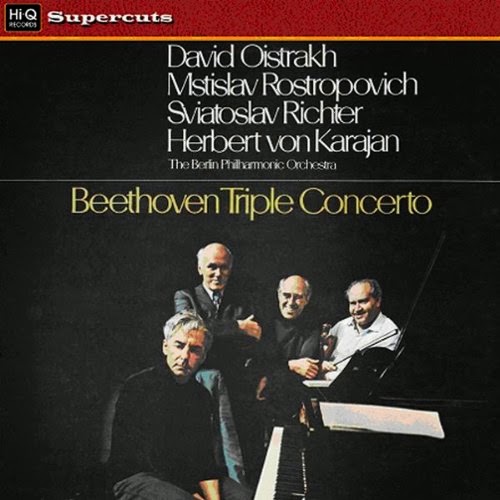
David Oistrakh, Mstislav Rostropovich and Sviatoslav Richter join the Berlin Philharmonic Orchestra conducted by Herbert von Karajan for a truly legendary recording event! 

The label waited many years to get these legendary artists together for this recording and the result was one of the greatest recordings this work has ever received.

“The warm, expansive music-making confirms even more clearly than before that the old view of this as one of Beethoven's weaker works is quite wrong. The three Soviet soloists revel in the multiplicity of ideas, with Richter in the spare piano part providing a tautening influence.” Penguin Guide, 2011 edition

With three soloists of this high caliber sharing the stage in one concert is quite something, but to have them playing on the same work is fairly unheard of. Couple them with Herbert Von Karajan and what have you got - a flawlessly intuitive recording, especially on the heart-rending second movement.

There is a marvelous dialogue taking place in this concerto between the three main players, David Oistrakh on violin, Mstislav Rostropovich on cello, Sviatoslov Richter on piano, and the Berlin Philharmonic Orchestra masterfully conducted by Herbert von Karajan. These were the great classical maestros of days gone by.

Conductor, Herbert von Karajan
Violinist, David Oistrakh
Cellist, Mstislav Rostropovich
Pianist, Sviatoslav Richter 
The Berlin Philharmonic Orchestra


 *original post May 2, 2011


Sunday, February 10, 2013

Gala from Berlin


Gala from Berlin

Sir Simon Rattle conducts "Gala from Berlin" featuring
Lang Lang and the Berliner Philharmoniker


You don't need a passport to see the Berliner Philharmoniker, conducted by Sir Simon Rattle and featuring piano superstar Lang Lang! In this encore HD broadcast from the Philharmoniker's home concert hall in Berlin - the Philharmonie - the world-renown orchestra presents works by two Russian composers:
Sergei Rachmaninov's Second Piano Concerto highlights Lang Lang's virtuosity and the Philharmoniker's supple orchestral sound. The Nutcracker Suite by Piotr Ilych Tchaikovsky completes the program.

Russian composer, pianist, and conductor Sergei Wassiljewitsch Rachmaninoff
(1. April 1873 – 28. March 1943) completed his second piano concerto in 1901 after a long period of stagnation and depression, caused by the failure of his 1. piano concerto. In 1900 he started a hypnosis therapy with the Russian psychologist Dr. Nikolai Dahl (1860 – 1939) and Rachmaninoff began to recover his confidence. As it was Dr. Nikolai Dahl, who persuaded and convinced him to go on with his compositional work, the piano concerto No.2, which was a big success, is dedicated to Dr. Nikolai Dahl. 

In this version, the piano is played by the young, Chinese shooting star Lang Lang, who got his first piano lessons at the age of just 3 years. Lang Lang became one of the most renowned and famous pianists of the 21th century and has been honored with an abundance of awards, but he is also under fire from all sides. Some critics have given him the nickname Bang Bang, criticizing that his playing is vulgar and lacks sensitivity. 

Others have described him as immature, though praised his ability to conquer crowds with youthful bravado. While some of these critics seem to grudge his enormous popularity and success, others praise the young talent, like the Chinese conductor Jahja Ling (born 25 October 1951), who remarked, “Lang Lang is special because of his total mastery of the piano… He has the flair and great communicative power.”


The Berliner Philharmoniker and pianist Lang Lang perform Sergei Rachmaninov: Piano Concerto No. 2 in C minor, Op. 18
Frédéric Chopin: Etude No. 1, Op. 25