If There Is Much In The Window There Should Be More In The Room

Tuesday, May 14, 2013

Nathan Milstein. Jakob Ludwig Felix Mendelssohn Bartholdy - Violin Concerto №1


Nathan Milstein. Jakob Ludwig Felix Mendelssohn Bartholdy - Violin Concerto 1


Felix Mendelssohn's Violin Concerto in E minor, Op. 64 is his last large orchestral work. It forms an important part of the violin repertoire and is one of the most popular and most frequently performed violin concertos of all time. A typical performance lasts just under half an hour.

Mendelssohn originally proposed the idea of the violin concerto to Ferdinand David, a close friend and then concertmaster of the Leipzig Gewandhaus Orchestra. Although conceived in 1838, the work took another six years to complete and was not premiered until 1845. During this time, Mendelssohn maintained a regular correspondence with David, seeking his advice with the concerto. The work itself was one of the violin concertos of the Romantic era and was influential to the compositions of many other composers.

Although the concerto consists of three movements in a standard fast–slow–fast structure and each movement follows a traditional form, the concerto was innovative and included many novel features for its time. Distinctive aspects of the concerto include the almost immediate entrance of the violin at the beginning of the work (rather than following an orchestral preview of the first movement's major themes, as was typical in Classical era concertos) and as a whole, the concerto has a through-composed form, in which the three movements are melodically and harmonically connected and played attacca (each movement immediately following the previous one).

The concerto was initially well received and soon became regarded as one of the greatest violin concertos of all time. The concerto remains popular and has developed a reputation as an essential concerto for all aspiring concert violinists to master, and usually one of the first Romantic era concertos they learn. Many professional violinists have recorded the concerto and the work is regularly performed in concerts and classical music competitions. -  Wikipedia


Nathan Milstein (1903 - 1992) was a Russian-born American virtuoso violinist.

Widely considered one of the finest violinists of the 20th century, Milstein was known for his interpretations of Bach's solo violin works and for works from the Romantic period.

He was also known for his long career: he performed at a high level into his mid 80s, retiring only after suffering a broken hand.was called the "prince of the violin" (and at one time, the "prince of the bow"). Harold Schonberg, in his obituary of Milstein published in The New York Times , wrote his famous line, "He could well have been the most nearly perfect violinist of his time".

He received a Grammy Award in 1975 for his recording of Bach's sonatas and partitas, and was awarded the Légion d'honneur by France in 1968. He was also awarded Kennedy Center honors by President Ronald Reagan.

A recital he gave in Stockholm in July 1986 proved to be his final performance. An accident shortly afterwards ended his career.

For most of his career he performed on the "Milstein (Maria Teresa), Goldman" Stradivarius of 1716 and for a short period the "Dancla" Stradivarius of 1710.


Monday, May 13, 2013

Napoleon’s Oraculum (1839)


Napoleon’s Oraculum (1839)


Link to Open Library page view

In 1813 Napoleon was defeated at Leipzig. However he left behind him a "Cabinet of Curiosities" among which a Prussian officer discovered the following Oraculum. Originally this Oraculum had been discovered in one of the Royal tombs of Egypt during a French military expedition of 1801. 

The emperor ordered the manuscript to be translated by a famous German scholar and antiquarian, and was translated into English in 1822. From that time onwards the Oraculum remained one of the emperor’s most treasured possessions. 

He consulted it on many occasions and it is said to have "formed a stimulus to his most speculative and most successful enterprises." As it states in the 1839 edition of the Oraculum, “Happy had it been for him, had he abided or been ruled by the answers of this Oracle.”
This story is highly unlikely for a number of reasons. The Rosetta Stone, which translates Egyptian hieroglyphs into Greek, was not fully deciphered until the 1820s. It would have been impossible for Napoleon’s “German scholar” to translate the Oraculum with the detail necessary for consultation. 


Friday, May 3, 2013

Mahler Symphony No 5 Adagietto - Sir Simon Rattle


Mahler Symphony No 5 Adagietto - Sir Simon Rattle 


Mahler was best known during his own lifetime as one of the leading orchestral and operatic conductors of the day, but he has since come to be acknowledged as among the most important post-romantic composers – a remarkable feat for a figure whose mature creativity was concentrated in just two genres: song and symphony.

Besides the nine completed symphonies, his principal works are the song cycles Lieder eines fahrenden Gesellen (usually rendered as ‘Songs of a Wayfarer’, but literally ‘Songs of a Travelling Journeyman’) and Kindertotenlieder (‘Songs on the Death of Children’), and the synthesis of symphony and song cycle that is Das Lied von der Erde (‘The Song of the Earth’).

Mahler told fellow composer Jean Sibelius in 1907 that “a symphony should be like the world: it must embrace everything”; putting this philosophy into practice, he brought the genre to a new level of artistic development.

After Beethoven, fifth symphonies became special landmarks for composers working in the Austro-German symphonic tradition. Mahler’s is an epic work: large in scale, extreme in its expressive character, abundant in its musical ideas and invention.

Its five movements create a broad sonic arch, capped by an elaborate Scherzo. Flanking this, to start the symphony, are a funeral march followed by music of violent intensity; and following the Scherzo, a dream-like Adagietto and an ebullient, contrapuntally embellished finale.


Thursday, May 2, 2013

N A U M A C H I A


Naumachia


Water Battles at the Colosseum Roman amphitheater old engraving Charpentier1782

Although the Colosseum served for many centuries as a center of hideous spectacle and barbarous cruelty, at the time of its construction, 
 A naumachia held at the Colosseum. Illustration by G. Nispi-Landi, 1913

Romans saw it as part of the rightful restoration into public hands of land which had been illegally expropriated by the despised Emperor Nero. 


At the very heart of Rome, from the Palatine to the Esquiline, Nero had built a large private estate, the symbolism of which had been plain to everyone. 


Nero had even blocked the people's access to the Sacre Via, Rome's most sacred thoroughfare and,


L- The_Arch_of_Titus_on_the_Via_Sacra,_Rome


in a city which traditionally frowned upon ostentation in private dwellings even for the rich, built himself a huge and magnificent palace which became known as the Domus Aurea or "Golden House".


 An 18th Century print by J Blundell shows the scale of Nero's Golden Palace, which, if completed, would have spanned a third of the city of Rome
 Nero-Golden-House-Engraving
 
On a ridge on the northern face of the Palatine, Nero had erected for himself a colossal 36 metre high bronze statue and in the middle of the palace grounds was a large artificial lake. After Nero's eventual disgrace and death, his successors competed with one another to break up his estate and to replace it with structures of public utility. 


To this end, Emperor Vespasian ushered in an era of long term peace and prosperity, and undertook new public building projects, filled in the lake and built the Amphitheatrum Flavium.

L -Vespasian planning the colosseum


He also moved closer to it the Colossus of Nero which he changed to represent to the god of the Sun.


It is this combination statue and amphitheater which much later led to the site being known as the famous Flavian Amphitheater,

(the Colosseum), which still stands today. 


L- Colosseum aerial view


Considering the watery origins of the site, it seems somehow appropriate that some of the earliest spectacles held there had an aquatic theme.


Following precedents set by Julius Caesar and Augustus, the amphitheater was used as a venue for naumachia, mock sea battles which were designed to thrill and divert the masses. 

Being located very close to a major aqueduct, the arena of the Colosseum was filled with water up to a height of 1.5 meters.


Then scale replicas of naval vessels were floated on the water and manned with presumably very reluctant crews of prisoners who were forced to battle for their lives.

The hand-colored Dutch engraving (1663) from the Netherlands Maritime Museum (top) is based upon an etching by Étienne du Pérac that was commissioned by the Veronese scholar Onofrio Panvinio for his book De Ludis. Based upon measurements and details provided by the author, the copper plate was etched between 1565-1566 and is almost identical to one du Pérac later produced for a catalog of engravings by Antonio Lafréry on ancient Rome. This book was published in 1600, a second edition of which is in the collection of the Canadian Centre for Architecture, from which the engraving above has been taken.

Tuesday, April 9, 2013

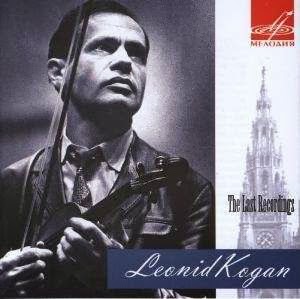
Tchaikovsky / L Kogan, 1959: Violin Concerto, Op. 35 - C Silvestri, Paris Conservatory (Vinyl LP)


The Violin Concerto in D major, Op. 35, written by Pyotr Ilyich Tchaikovsky in 1878, is one of the best known of all violin concertos. It is also considered to be among the most technically difficult works for violin.

For a complete overview of its history, please refer to:
http://www.tchaikovsky-research.net/en/Works/Concertos/TH059/index.html


One of the twentieth century's greatest violinists, Leonid Kogan was less widely known than his somewhat older contemporary David Oistrakh, but no less a first-tier artist. More concentrated in tonal focus and with a quicker vibrato than Oistrakh and others of the Russian school, Kogan was avowedly a man of his time.

His espousal of the four-octave scale for exercises assured the infallibility of his technique by strengthening his fingering hand in the upper positions.

Kogan's recordings and interpretations are impressive. His manner of varying the singing tone of his violin, the intensity of his sound, and the fantasy and sensations he expresses are truly magnificent. Oistrakh, after hearing him play in a concert when Kogan was only 17 years old remarked " Kogan played very precisely, with astonishing mastery and maturity. I was amazed by his sound and the breath of the movement."

Kogan would perform all of Paganini's Capricci, for example at the Small Hall of the Moscow Conservatory, and these concerts were always a unique experience for those who attended.

Kogan's style is considered more modern than that of Oistrakh. Kogan's playing, according to Boris Schwarz, was leaner, more angular and aggressive. It is more rhythmic and propulsive than Oistrakh's meditative approach and his vibrato faster and purer. His style was perhaps more objective than that of Oistrakh, and certainly very different. He avoided flamboyant effects, and was rather reticent on stage.

His violin was a Guarneri del Gesù dated 1726 ( although he also had another one dated 1733 ) , which Oistrakh acquired for him in the early 1960s. Kogan had played a Stradivarius in the early years of his career. His son, Pavel, born in 1952, became a famous violinist and conductor. His daughter, Nina, a pianist, accompanied him in later years.

Sadly Leonid Kogan died prematurely, in a train, at the Mytischa railway station while on tour. He was only 58 years old. Kogan was made an Honoured Artist in 1955, a People's Artist of the USSR in 1964, and received the Lenin Prize in 1965.


Leonid Kogan is soloist, and Constantin Silvestri leads the Paris Conservatory Orchestra in this 1959 recording of the Tchaikovsky D major violin concerto. From the LP you see here, issued in 1974 on the British EMI budget label "Classics For Pleasure," catalogue number CFP 40083.

1. Allegro moderato - Moderato assai
2. Canzonetta (Andante)
3. Allegro vivacissimo


Wednesday, March 27, 2013

Childish Superstition: Einstein's letter makes view of religion relatively clear


"Science without religion is lame, religion without science is blind." So said Albert Einstein, and his famous aphorism has been the source of endless debate between believers and non-believers wanting to claim the greatest scientist of the 20th century as their own. A little known letter written by him, however, may help to settle the argument - or at least provoke further controversy about his views. Being in a private collection for more than 50 years, the document leaves no doubt that the theoretical physicist was no supporter of religious beliefs, which he regarded as "childish superstitions".

Einstein penned the letter on January 3 1954 to the philosopher Eric Gutkind who had sent him a copy of his book Choose Life: The Biblical Call to Revolt. The letter went on public sale a year later and has remained in private hands ever since. 

 
The Nobel Prize-winning scientist questions the existence of God. In the letter, Einstein is frank about his views on the supernatural. "The word God is for me nothing more than the expression and product of human weaknesses, the Bible a collection of honourable, but still primitive legends which are nevertheless pretty childish. No interpretation no matter how subtle can (for me) change this." 
 
Einstein, who was Jewish and who declined an offer to be the state of Israel's second president, also rejected the idea that the Jews are God's favored people.

L -
Science vs the divine: Despite being agnostic, Einstein felt an 'affinity' to the Jewish people


"For me the Jewish religion like all others is an incarnation of the most childish superstitions. And the Jewish people to whom I gladly belong and with whose mentality I have a deep affinity have no different quality for me than all other people. As far as my experience goes, they are no better than other human groups, although they are protected from the worst cancers by a lack of power. Otherwise I cannot see anything 'chosen' about them."
One of the country's leading experts on the scientist, John Brooke of Oxford University, admitted he had not heard of it. Einstein is best known for his theories of relativity and for the famous E=mc2 equation that describes the equivalence of mass and energy, but his thoughts on religion have long attracted conjecture.

His parents were not religious but he attended a Catholic primary school and at the same time received private tuition in Judaism. This prompted what he later called, his "religious paradise of youth", during which he observed religious rules such as not eating pork. This did not last long though and by 12 he was questioning the truth of many biblical stories.


"The consequence was a positively fanatic [orgy of] freethinking coupled with the impression that youth is being deceived by the state through lies; it was a crushing impression," he later wrote.

In his later years he referred to a "cosmic religious feeling" that permeated and sustained his scientific work. In 1954, a year before his death, he spoke of wishing to "experience the universe as a single cosmic whole". He was also fond of using religious flourishes, in 1926 declaring that "He [God] does not throw dice" when referring to randomness thrown up by quantum theory.

His position on God has been widely misrepresented by people on both sides of the atheism/religion divide but he always resisted easy stereotyping on the subject.
"Like other great scientists he does not fit the boxes in which popular polemicists like to pigeonhole him," said Brooke. "It is clear for example that he had respect for the religious values enshrined within Judaic and Christian traditions ... but what he understood by religion was something far more subtle than what is usually meant by the word in popular discussion."

Despite his categorical rejection of conventional religion, Brooke said that Einstein became angry when his views were appropriated by evangelists for atheism. He was offended by their lack of humility and once wrote. "The eternal mystery of the world is its comprehensibility."


Monday, March 25, 2013

Lang Lang - Live in Vienna


Filmed live in Vienna's legendary Musikverein concert hall, this release represents Lang Lang's second live recorded recital to date after the best-selling "Live at Carnegie Hall" in 2004, which marked his international breakthrough as a recording artist.


The program for his Sony debut features Lang Lang's first-ever recording of Beethoven sonatas: He is intense and focused in the famous "Appassionata", a milestone in the piano literature, sharp and lively in Beethoven's early C major Sonata op. 2, no. 3.  Virtuosity of a different order is displayed in his thrillingly colorful Albéniz's impressionistic memories of his native Spain in Book 1 of "Iberia."

The program closes with one of Prokofiev's explosive War Sonatas, the revolutionary Seventh Sonata. Finally, to celebrate the Chopin Bicentennial we hear three encores of this Polish genius's most popular works: the "Aeolian Harp" Etude, the "Heroic" Polonaise in A flat major, and the sparkling Grande Valse Brillante No. 2.

He is the most communicative pianist of his generation, with a huge following in the east, and for any open-minded listener there is seriously good piano playing in this fine recital from Vienna. Perhaps he is indulgent, but the technical command is peerless and the emotional warmth envelops us. He is surely the Horowitz of our generation.


Wednesday, March 20, 2013

Akhnaten - Prelude:Refrain,Verse 1,Verse 2


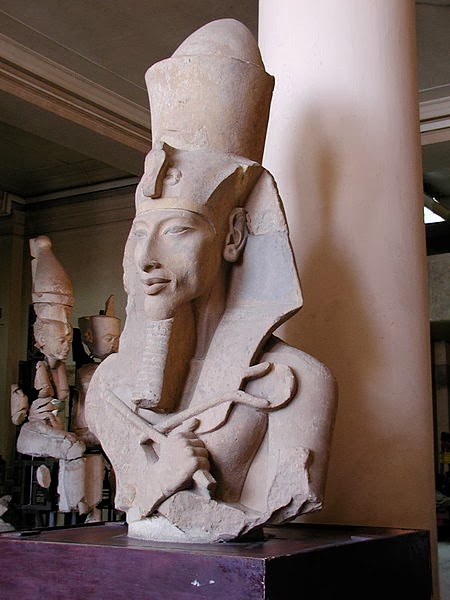
Akhenaten known before the fifth year of his reign as Amenhotep IV, was a Pharaoh of the Eighteenth dynasty of Egypt who ruled for 17 years and died perhaps in 1336 BC or 1334 BC. 

He is especially noted for abandoning traditional Egyptian polytheism and introducing worship centered on the Aten, which is sometimes described as monotheistic or henotheistic. An early inscription likens the Aten to the sun as compared to stars, and later official language avoids calling the Aten a god, giving the solar deity a status above mere gods.


Akhenaten tried to bring about a departure from traditional religion, yet in the end it would not be accepted. After his death, traditional religious practice was gradually restored, and when some dozen years later rulers without clear rights of succession from the Eighteenth Dynasty founded a new dynasty, they discredited Akhenaten and his immediate successors, referring to Akhenaten himself as "the enemy" in archival records.


An opera in three acts. Possessing a theatrical almost romantic quality,
Philip Glass takes the ancient myth setting it into the contemporary music
landscape with consummate ease while retaining the
primordial substance of the original story. 


Akhnaten, the third of Philip Glass's "portrait" operas (composed in 1983), is based on the life of the Egyptian pharaoh Akhnaten, who ruled Egypt from 1375 BC to 1358 BC. Like Einstein on the Beach and Satyagraha, it is not a "story" opera but an episodic-symbolic portrait of a historical personality whose visionary ideas dramatically changed the perceptions of the world around him. Here, Glass, in his own libretto, tells the story of the man who supposedly introduced monotheism into classic Egyptian culture (and thereby the Western world), thus complimenting the realms of science and politics as portrayed in his previous two operas. 

Tuesday, March 12, 2013

The Orientalists


The Orientalists


pyramids road, Gizah
 'The Pyramids Road, Gizah' by Edward Lear, British. Oil, 1873


As great art has the power to change the lives of those who create it; so it has the power to change the lives of those of us who view it.

The story of the Orientalists is a story of life. Of their lives and what they strove to accomplish and what they loved; and the story of the people they met and the places they recorded.

In July of 1798 Napoleon marched into Egypt with an army. He defeated the Turks at the battle of the Pyramids, stayed for a few weeks and then was driven out by the British. In the small amount of time that he was there he managed to do what he did best: he changed everything.

Following him came first a trickle and then a torrent of westerners into the Near and Middle East. The writers who wrote about their experiences and the artists who painted what they saw became known as the Orientalists. They traveled through Turkey, Iraq, Persia, Egypt, Lebanon, Palestine, Arabia and North Africa. With time this became an art movement and today we call it Orientalist art.

This movement spanned over a century and included hundreds of known artists. Many of them were giants of the art world and created beautiful paintings that seem almost photographic in detail.

Many of them took incredible risks and endured considerable hardship. Disease was the greatest hazard and gun battles with bandits were commonplace. At other times they were received with the greatest kindness and made lasting friendships.

They came from all over the world: from England, France, Belgium, Germany, Italy, Russia, America, and Australia. Some of them specialized in landscapes, in archeological themes, or in people. Some of them were very religious and created biblical scenes, some specialized in military history.

Others recorded the flora and fauna of the Near and Middle East. Encompassing many different painting styles and political leanings, the only generalization that can be made about them is that they were extremely diverse.

One common thread unites them; all who went were changed by the experience. From Charles Gleyre lying on the deck of a ship in the Mediterranean so sick that the captain and crew discussed if he were still alive or not, to Etienne Dinet making his pilgrimage to Mecca, the journey affected these men deeply.

Some even died there and others remembered their travels with crystalline clarity to the end of their lives. As great art has the power to change the lives of the those who create it; so it has the power to change the lives of those of us who view it.


Orientalist Art

The Orientalist art movement, although a predominantly 19th century phenomenon started in the time of the Renaissance and continued throughout the years emerging in the 21st century seen through new forms and techniques. Themes and places of interest to Orientalist artists span the geographical areas of Middle Eastern and North African Islamic countries. 

However, Orientalism as an art movement cannot be associated with any particular European country nor encapsulated in any of the local ‘schools’, as throughout the centuries it was exercised by different Western cultures who documented their experiences of extraordinary meetings with inhabitants of the ‘other’. 

Orientalism as a historical and cultural event has been uniting various aspects of cultural life for a number of centuries, including literature, fine arts, architecture, music, and philosophy, and has generated an exotic image within our consciousness, one that has a right to its own existence.


'Afternoon in Algiers' by Frederick Arthur Bridgman, American. Oil
'An Almeh with pipe' by Jean-Leon Gerome, French. Oil, 1873
'Angelica' by Charles Gleyre, Swiss. Watercolor, 1834.
'Arab Girl' by Louis-Joseph Anthonissen
'Arms Dealers' by Giulio Rosati, Italian. Watercolor

'Bashi-Bazouk Chieftain' by Jean-Leon Gerome, French. Oil, 1881.
'Bashi-Bazouks singing' by Jean-Leon Gerome, French. Oil, 1868
orientalist art
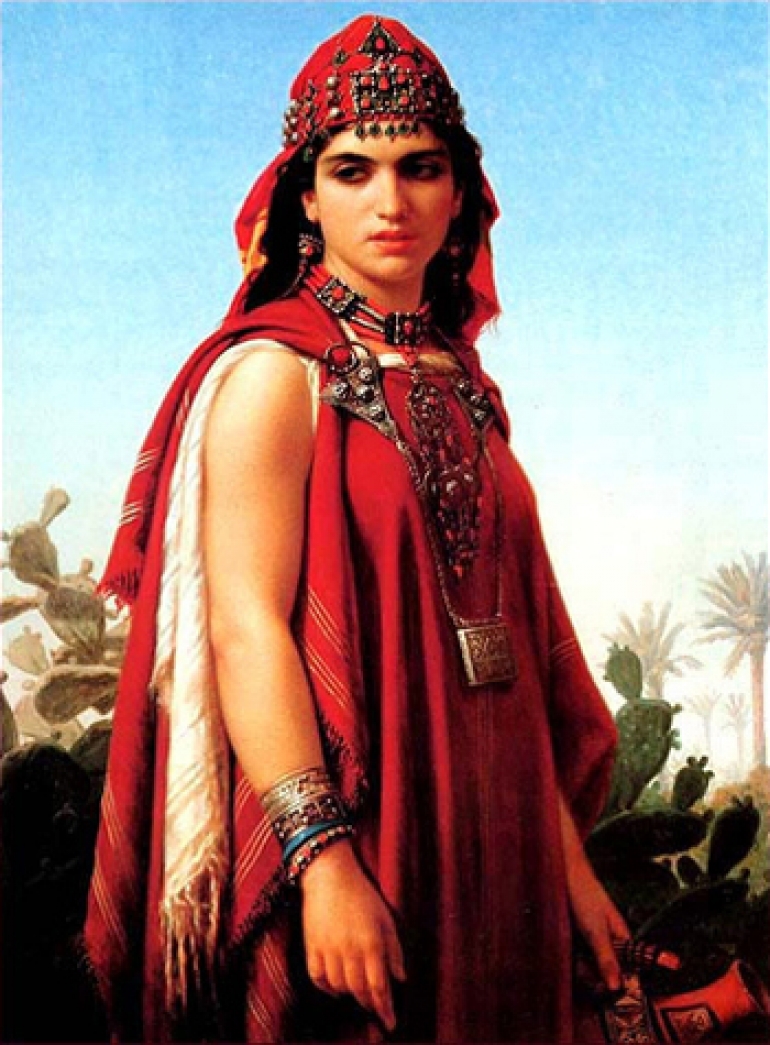
'Berber Woman' by Emile Vernet-Lecomte, French. Oil, 1870
'Bride arriving in a village, Biskra, Algeria' by Philippe Pavy, French. Oil, 1889
'Buffaloes bathing in the Nile' by Leon Belly, French. Oil, 1861
'Egyptian girl with a butterfly' by Leopold Carl Muller, Viennese. Oil, 1885
Fumee d'Ambre Gris' by John Singer Sargent, American. Oil, 1880
'Girls dancing and Singing' by Etienne Dinet, French. Oil, 1902